


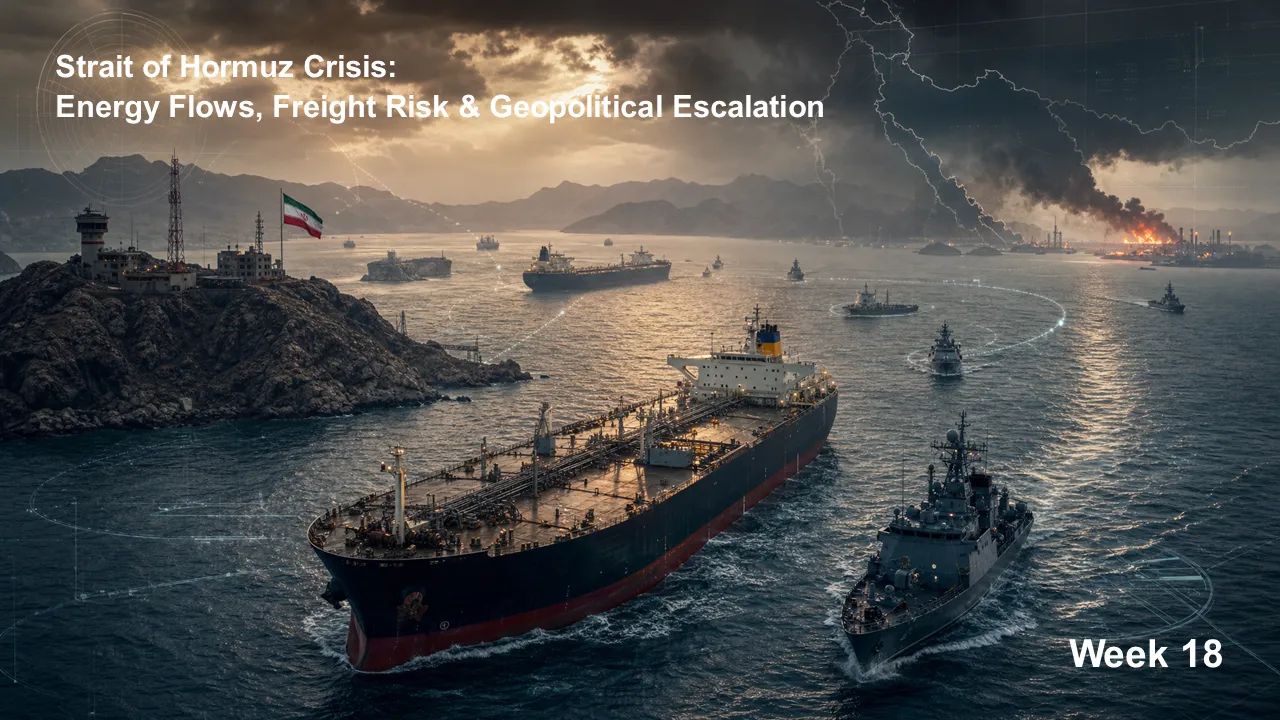
More than sixty days into the Strait of Hormuz disruption, expectations of a near-term negotiated resolution have weakened and market logistics are adjusting to sustained constraints rather than a temporary shock.
Traffic has remained sharply below normal levels, with only a handful of daily transits versus roughly 125 to 140 before the conflict, while Iranian enforcement focus near Larak Island continues to add delay and compliance risk.
War risk premiums have risen materially, with reported market levels typically around 0.5% to 1% of hull value under elevated risk conditions, and US officials have warned that any transit-related payments to Iran could create sanctions exposure under OFAC.
Tanker volatility is being driven by a shift toward Atlantic Basin supply, with US Gulf crude exports reaching sustained highs on Asian nominations, alongside a rebound in Venezuelan exports, which rose to 1.23 million bpd in April on 66 cargoes, up 14% from March.
Capesize average earnings were $36,800/day with the BCI up 4% w-o-w to 4,450. Panamax average earnings were $18,000/day with the BPI up 2% to 2,000. Supramax average earnings were $19,200/day with the BSI down 1% to 1,520. Handysize average earnings were $14,700/day with the BHSI up 2% to 815.
Capesize strengthened as C3 rose to $35/ton, with a 181,000 dwt fixed Tubarao with West Africa option to Qingdao at $34.45/ton.
Panamax stayed pressured on growing North Continent tonnage and limited transatlantic demand, with an 82,000 dwt fixed delivery Gibraltar for a fronthaul trip at $25,000/day.
Supramax momentum eased as activity slowed into the holidays and the US Gulf lost ground, with a 56,000 dwt fixed Mediterranean to East Coast India with fertiliser at $18,000/day.
Handysize remained supported by the US Gulf and South America, with a 37,000 dwt fixed SW Pass to Spain with grains at $17,000/day.
Capesize stayed supported on steady miner presence, with a 180,000 dwt fixed Dampier to Qingdao at $13.5/ton and C5 at $13.7/ton.
Panamax held comparatively firmer on steady demand from Australia, Indonesia and the wider North Pacific, with an 81,704 dwt fixed open Songxia for an Australian round at $23,000/day.
Supramax softened on weaker Indonesia and North Pacific demand, with a 64,000 dwt fixed delivery North China for redelivery Sri Lanka at $23,000/day.
Handysize benefited from tighter tonnage in Southeast Asia and the North Pacific, with a 42,600 dwt open Phu My placed on subjects to the Far East with salt at $17,000/day.
VLCC softened, with TD15 West Africa to China at $100,000/day, down 4.5% w-o-w, and US Gulf to China assessed at $94,000/day.
Suezmax returns fell, with TD20 West Africa to UK Continent at $79,000/day, down 20%, and TD27 Guyana to UK Continent at $85,000/day, down 18%.
Aframax strengthened in the Atlantic, with TD25 US Gulf to Continent at $116,500/day, up 19%, and TD26 East Coast Mexico to US Gulf at $183,340/day, up 37%.
LR held firm, with TC20 MEG to UK Continent at $154,800/day, up 5.5%.
MR stayed weak, with TC21 US Gulf to Caribs at $46,000/day, down 24.6%, and TC2 Continent to US Atlantic Coast at $18,000/day, down 31.7%.
VLCC softened in the MEG, with TD3C MEG to China at $403,000/day, down 11% w-o-w.
Suezmax East of Suez remained limited and largely theoretical, leaving rates sensitive to changes in regional disruption.
Aframax cross-Med softened, with TD19 at $94,200/day, down 8.5% w-o-w.
LR was mixed, with TC1 MEG to Japan at $159,200/day, up 4%, and TC5 MEG to Japan at $126,600/day, down 3.5%.
MR TC7 Singapore to East Coast Australia eased to $42,000/day, down 5% w-o-w.
Over the past twelve months, Greek interests remained the leading sellers with 321 vessels sold across sectors, versus 157 sales by Chinese sellers. Greek selling was led by 151 dry bulk and 123 tankers, plus 32 containers and 10 gas carriers, while Chinese selling comprised 103 dry bulk, 35 tankers, 10 containers and 6 gas carriers.
On the buying side, Greece ranked first with 233 purchases and China followed with 214, with Greek buying led by 121 dry bulk and 85 tankers and Chinese buying led by 166 dry bulk and 37 tankers, alongside container and gas acquisitions.
This post provides a high-level overview of the ongoing Strait of Hormuz disruption, energy flow realignment, and current freight market volatility across dry bulk and tanker segments.
The full Allied QuantumSea Weekly Market Report – Week 18 includes:
In-depth analysis of the Strait of Hormuz crisis and evolving geopolitical risk
Detailed assessment of Atlantic Basin crude substitution and changing tanker flows
War risk insurance, sanctions exposure & compliance implications for shipping markets
Dry bulk and tanker earnings tables across all vessel classes
Atlantic & Pacific route-level freight analysis with fixture benchmarks
Baltic indices, TCE calculations & historical trend comparisons
Secondhand S&P transactions, buyer–seller positioning & asset value trends
Recycling activity and scrap pricing indicators
👉 Fill in the form below to subscribe and receive the complete PDF directly in your inbox every week.