


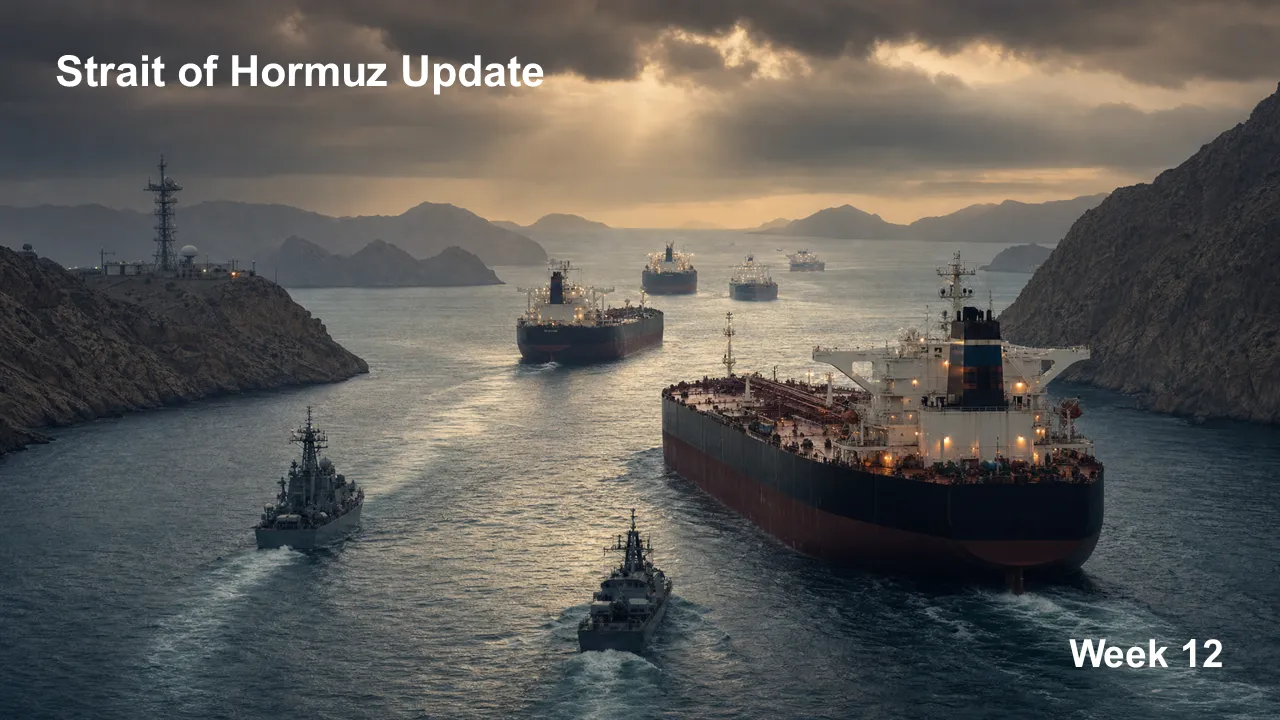
The Strait of Hormuz remains neither fully closed nor operating as a normal commercial corridor, with transits still described as extremely limited and shaped by security conditions, political dynamics, and operational constraints.
Tracking confirms the route is physically passable, but AIS based visibility is affected by signal disruption and reduced reporting, meaning observed activity does not capture everything.
The operating environment is increasingly permission based, with some vessels routing close to Iranian territorial waters and a de facto corridor around Larak Island emerging under selective access conditions.
War risk capacity has tightened and insurance terms have become a key swing factor for participation, while navigation disruption and constrained operating conditions continue to raise costs and reduce trade flow visibility.
Capesize average earnings were $27,000/day, with the BCI up 3% w o w to 2,971. Panamax average earnings were $17,100/day, with the BPI up 3.6% w o w to 1,904. Supramax average earnings were $15,500/day, with the BSI down 4.6% w o w to 1,224. Handysize average earnings were $13,400/day, with the BHI down 6.5% w o w to 744.
Capesize strengthened on Brazil and West Africa to China with C3 moving above $30/ton at its peak, including a 180,000 dwt fixed via Brazil with a West Africa option to Qingdao at $27.40/ton.
Panamax firmed on improved mineral and grain demand, including an 82,900 dwt fixed delivery Cape Henry for a trip to India with coal at $25,000/day plus a $550,000 ballast bonus.
Supramax stayed under pressure in the US Gulf and South Atlantic on a growing list of open ships, including a 56,000 dwt fixed delivery SW Pass to East Coast Mexico with grains at $16,250/day.
Handysize softened in the South Atlantic and US Gulf on thin fresh demand, including a 39,000 dwt fixed US Gulf to Turkey with grain at $19,250/day.
Capesize had supportive miner volumes but C5 eased to $11.71/ton by Friday, including a 180,000 dwt fixed West Australia to China at $12.00/ton.
Panamax demand for Indonesia to India and West Australia rounds remained present but fixing stayed cautious, including an 81,800 dwt fixed from Kakogawa for a Pacific round with minerals redelivery Singapore Japan at $23,750/day.
Supramax sentiment stayed soft as charterers pushed lower ideas and cargo volumes remained limited, including a 61,000 dwt fixed open Tianjin for a North Pacific voyage redelivery Singapore at $17,000/day.
Handysize trading remained slow with sentiment negative, including a 38,000 dwt placed on subjects via West Australia to Japan at $13,500/day.
VLCC softened on West Africa to China with TD15 at $106,900/day, while US Gulf and Brazil East activity provided some support.
Suezmax stayed mixed, with TD20 West Africa to Continent firming to $127,000/day and TD27 Guyana to UK Continent softening to $123,000/day as enquiry kept Atlantic tonnage occupied.
Aframax extended gains, with TD25 US Gulf to Continent at $128,800/day and TD26 East Coast Mexico to US Gulf at $165,000/day, while TD19 cross Med firmed to $185,500/day on a thin position list.
LR2 TC20 ME Gulf to UK Continent softened to $78,000/day as westbound pricing eased.
MR held firm in the Atlantic, with TC21 US Gulf to Caribs at $93,800/day and TC2 ARA to US Atlantic Coast at $19,000/day on steady enquiry and strong US Gulf returns.
VLCC eased in the MEG, with TD3C ME Gulf to China at $384,500/day as visibility on AG loadings stayed poor and flows remained distorted.
Suezmax East of Suez stayed highly sensitive to war related disruption, with volatility driven by changing VLCC competition and shifting positioning.
LR2 TC1 ME Gulf to Japan firmed to $89,500/day and LR1 TC5 ME Gulf to Japan rose to $62,500/day, with pricing influenced by limited AG loadings, Yanbu exports and ships ballasting away from the Gulf.
MR TC7 Singapore to East Coast Australia rose to $20,000/day, though East of Suez trading remained constrained by Gulf disruption and shifting positioning.
Over the past twelve months, Greek interests led selling with 318 vessels across sectors, versus 146 for Chinese sellers. Greek selling was led by 150 dry bulk and 122 tankers, plus 34 containers and 5 gas carriers, while Chinese selling comprised 93 dry bulk, 34 tankers, 11 containers and 5 gas carriers.
On the buying side, China ranked first with 222 purchases and Greece followed with 213, with Chinese buying led by 171 dry bulk and 40 tankers, while Greek buying was led by 113 dry bulk and 67 tankers, plus 26 containers and 2 gas carriers.
This post provides a high-level view of current Strait of Hormuz operating conditions and their impact on freight markets across dry bulk and tanker segments.
The full Allied QuantumSea Weekly Market Report – Week 12 includes:
· In-depth analysis of Strait of Hormuz operational dynamics and transit constraints
· Vessel tracking insights and implications of AIS disruption and limited visibility
· War risk insurance developments and their impact on trade participation
· Detailed dry bulk and tanker earnings tables across all vessel classes
· Atlantic & Pacific route-level freight breakdowns with fixture benchmarks
· Baltic indices, TCE calculations & historical trend comparisons
· Secondhand S&P transactions, buyer–seller positioning & asset value trends
· Recycling activity and scrap pricing indicators
👉 Fill in the form below to subscribe and receive the complete PDF directly in your inbox every week.