


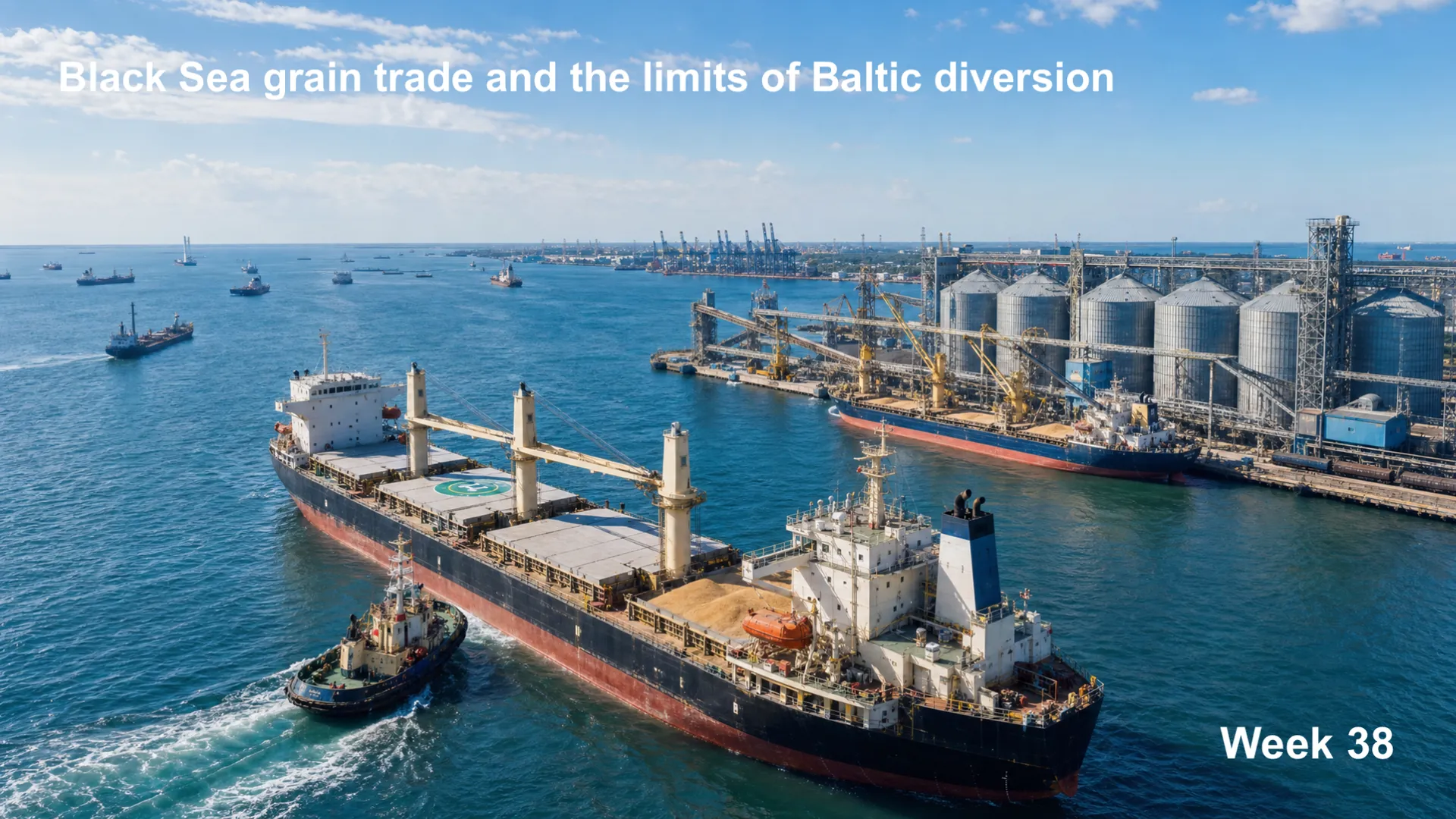
Black Sea grain disruption continues to weigh on vessel activity and regional export flows, with alternative Baltic and Danube routes absorbing only part of the displaced volumes. Combined Russian and Ukrainian wheat exports for July to September are forecast well below last year and the five year average, marking the weakest period in more than a decade. Ukrainian Black Sea grain carrier calls fell sharply in August as attacks intensified, while Russia also recorded a steep year on year fall in early September grain and pulse shipments. Russian Baltic ports are taking a larger role, supported by higher rail demand and terminal conversions in Baltic and Arctic ports, but available capacity remains far below the scale historically handled through the Black Sea and Sea of Azov. Insurance discussions have also become more complex after the Joint War Committee expanded the listed Black Sea risk area, while Latvian tariff and transit proposals add another layer of policy uncertainty.
Capesize average earnings were $48,800/day, with the BCI at 5,768 down 5% w o w. Panamax average earnings were $20,300/day, with the BPI at 2,251 down 6% w o w. Supramax average earnings were $22,300/day, with the BSI at 1,767 up 3% w o w. Handysize average earnings were $17,800/day, with the BHSI at 988 up 5% w o w.
Capesize South Brazil and West Africa to China gained momentum on stronger fixing activity, reduced ballaster availability and firmer October enquiry, with C3 at $42.96/ton.
Panamax came under pressure from prompt tonnage availability and slower fresh enquiry, although fronthaul demand offered support, with an 82,000 dwt fixed from the North Continent for a North Coast South America to China trip at $34,750/day.
Supramax was broadly flat in the US Gulf, while the Continent tightened as fertilizer and grain stems absorbed tonnage, with a 63,000 dwt fixed from the US Gulf to Vietnam at $33,000/day.
Handysize strengthened across the Continent, Mediterranean, US Gulf and South Atlantic on tight prompt tonnage and stronger scrap, grain and minor bulk demand, with a 40,000 dwt fixed from the Mississippi River to Turkey at $28,000/day.
Capesize softened as prompt tonnage outweighed fresh demand, with C5 easing to $16.575/ton.
Panamax remained active on Australian, Indonesian and North Pacific demand, but expanding tonnage lists and cautious charterer bidding weighed on rates, with an 84,000 dwt fixed for a trip via Indonesia at $22,500/day.
Supramax strengthened on North Pacific grains, backhaul demand and firmer Indonesian coal activity, with an Ultramax fixed from Chittagong via Indonesia to India at $22,000/day.
Handysize was largely steady to subdued on limited fresh enquiry, with a 39,000 dwt fixed from Yokohama via Japan to Malaysia with slag in the mid $17,000s/day.
VLCC strengthened sharply, with TD15 West Africa to China at $527,500/day and TD22 US Gulf to China at $400,300/day as Atlantic supply tightened and long haul demand improved.
Suezmax held firm, with TD20 West Africa to UK Continent at $238,800/day and TD27 Guyana to UK Continent at $248,400/day, supported by split stems from Brazil and West Africa and US Gulf to East enquiry.
Aframax was mixed, with TD25 US Gulf to Continent at $123,500/day and TD26 East Coast Mexico to US Gulf at $132,500/day, while TD19 cross Med rose to $213,700/day.
LR stayed elevated, with TC20 ME Gulf to UK Continent at $246,900/day.
MR improved overall, with TC21 US Gulf to Caribs at $14,100/day and TC2 Continent to US Atlantic Coast returning to positive territory at $1,400/day.
VLCC surged in the ME Gulf, with TD3C ME Gulf to China at $1,241,100/day and TD34 Gulf of Oman to China at WS 803.57, equivalent to $150.03/ton.
Suezmax had no dedicated East of Suez benchmark provided, while wider earnings were supported by VLCC scarcity and split stems.
LR strengthened, with TC1 ME Gulf to Japan at $237,500/day and TC5 ME Gulf to Japan at $171,700/day.
MR strengthened in the Far East, with TC7 Singapore to East Coast Australia at $51,800/day.
Over the past twelve months, Greece led secondhand selling with 323 vessels across sectors, versus 166 sales by Chinese sellers. Greek sales were led by 167 dry bulk and 124 tankers, plus 20 containers and 8 gas carriers, while Chinese sales comprised 107 dry bulk, 38 tankers, 11 containers and 5 gas carriers. On the buying side, Greece recorded 230 purchases and China followed with 213, with Greek buying led by 111 dry bulk and 93 tankers, plus 19 containers and 1 gas carrier, while Chinese buying was led by 165 dry bulk and 37 tankers, plus 7 containers and 1 gas carrier.