


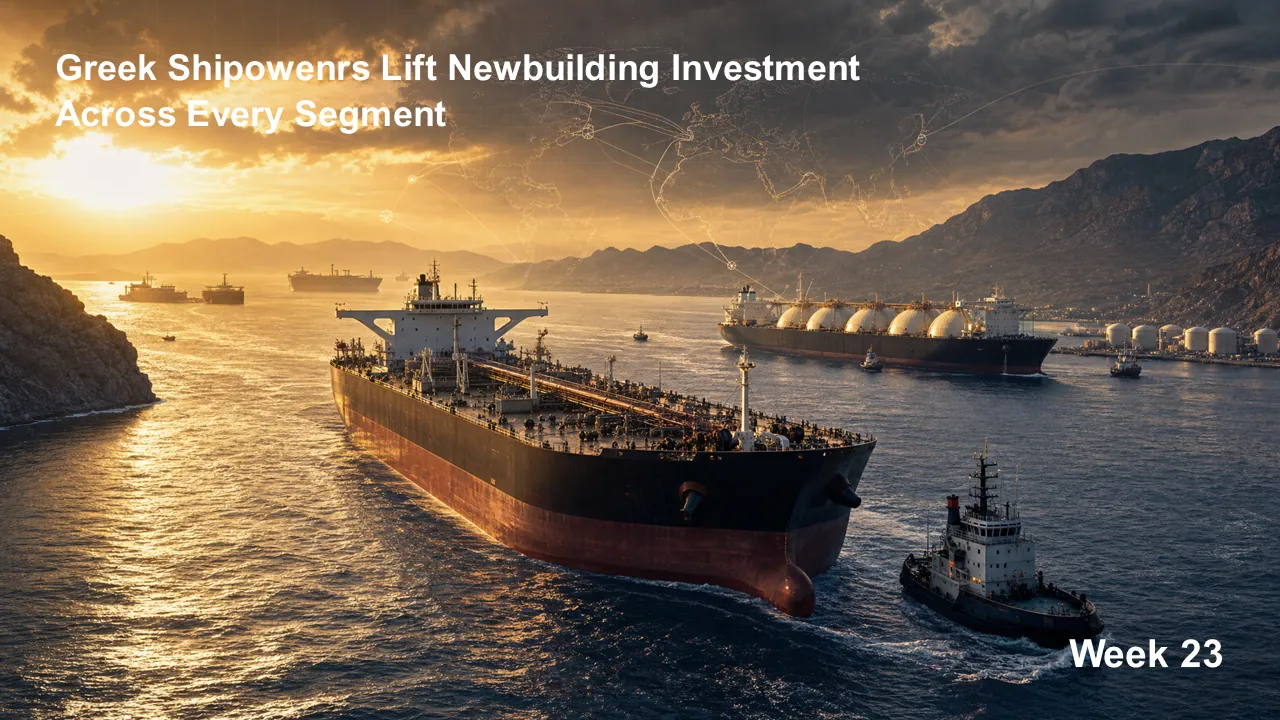
Greek newbuilding investment has broadened into a clear multi segment cycle as 2026 progresses, moving beyond the initial tanker focus seen in March.
The early momentum was tanker led, with the Hormuz crisis pushing Greek owners first into crude and Suezmax orders, before activity widened through April and May into containers, Kamsarmax bulkers, gas carriers and further tanker deals. Delivery placement is concentrated mainly in the 2027 to 2030 window, pointing to owners prioritising yard access with a longer view rather than short dated capacity.
Despite the unresolved Hormuz backdrop and higher bunker and voyage cost risk, ordering appetite has remained firm, with a meaningful share tied to energy transportation across crude, LNG and LPG related segments, and Posidonia discussions indicating that renewal and growth themes remain active across more than one vessel class.
Dry Bulk Analysis – Week 23 2026
Capesize average earnings were $44,400/day, with the BCI at 4,893 down 11% w-o-w. Panamax average earnings were $20,100/day, with the BPI at 2,236 down 5% w-o-w. Supramax average earnings were $20,100/day, with the BSI at 1,588 up 1% w-o-w. Handysize average earnings were $15,500/day, with the BHSI at 864 up 2% w-o-w.
Dry Atlantic Analysis – Week 23 2026
Capesize South Brazil and West Africa to China softened on thin enquiry, with C3 at $36.50/ton and a 180,000 dwt fixed Tubarao to Qingdao at $36.50/ton.
Panamax remained pressured on a growing tonnage list in the North Continent and limited mineral and grain cover, with an 82,000 dwt fixed for an ECSA to Singapore Japan grains trip at around $24,500/day.
Supramax held support from the US Gulf on tighter availability, with a 64,000 dwt fixed delivery SW Pass to West Coast Central America at $29,500/day.
Handysize trading stayed limited overall, with a 35,000 dwt fixed from the US East Coast to ARAG with coal at $20,000/day.
Dry Pacific Analysis – Week 23 2026
Capesize weakened on limited miner activity and thinner cargo flow, with C5 at $13.920/ton and a 180,000 dwt fixed Port Hedland to Qingdao at $14.40/ton.
Panamax saw Indonesia and Australia provide some support but a wider bid offer gap limited fixtures, with an 82,000 dwt fixed delivery Tomogashima via East Australia to South China at $25,500/day.
Supramax improved selectively but prompt tonnage in the south kept conditions uneven, with a 63,000 dwt fixed from Weda for an Indonesia round with redelivery Southeast Asia at $25,000/day.
Handysize rates were supported by steadier demand and tighter tonnage in parts of Asia, with a 43,000 dwt fixed via North Australia to China Japan at $19,000/day.
Wet Atlantic Analysis – Week 23 2026
VLCC earnings eased on weaker Atlantic routes, with TD15 West Africa to China at $84,900/day and TD22 US Gulf to China at $95,600/day, while average earnings were $193,900/day down 2% w-o-w.
Suezmax Atlantic routes stayed under pressure, with TD20 West Africa to UK Continent at $56,000/day and TD27 Guyana to UK Continent at $53,200/day, while average earnings were $88,600/day up 0.5% w-o-w.
Aframax earnings rose on a rebound in the US Gulf and stronger Med performance, with TD25 at $63,700/day, TD26 at $69,000/day and TD19 cross-Med at $67,200/day, with average earnings at $58,500/day up 30% w-o-w.
LR rates eased, with TC20 ME Gulf to UK Continent at $131,100/day.
MR was mixed, with TC21 US Gulf to Caribs at $48,900/day while TC2 Continent to US Atlantic Coast fell to $2,500/day.
Wet Pacific Analysis – Week 23 2026
VLCC ME Gulf to China was assessed at $401,100/day, while TD34 Gulf of Oman to China was assessed at WS 135, equivalent to $25.30/ton.
Suezmax had no dedicated East of Suez benchmark provided in the current source pack.
LR rates eased in the MEG, with TC1 at $138,100/day and TC5 at $103,200/day.
MR TC7 Singapore to East Coast Australia eased to $28,900/day.
Over the past twelve months, buyer nationality was led by Greece with 262 purchases across sectors, including 32 dry bulk, 124 tankers, 82 containers and 21 gas carriers. Seller nationality data shows China recorded 23 sales across sectors, comprising 12 dry bulk, 2 tankers, 4 containers and 1 gas carrier.