


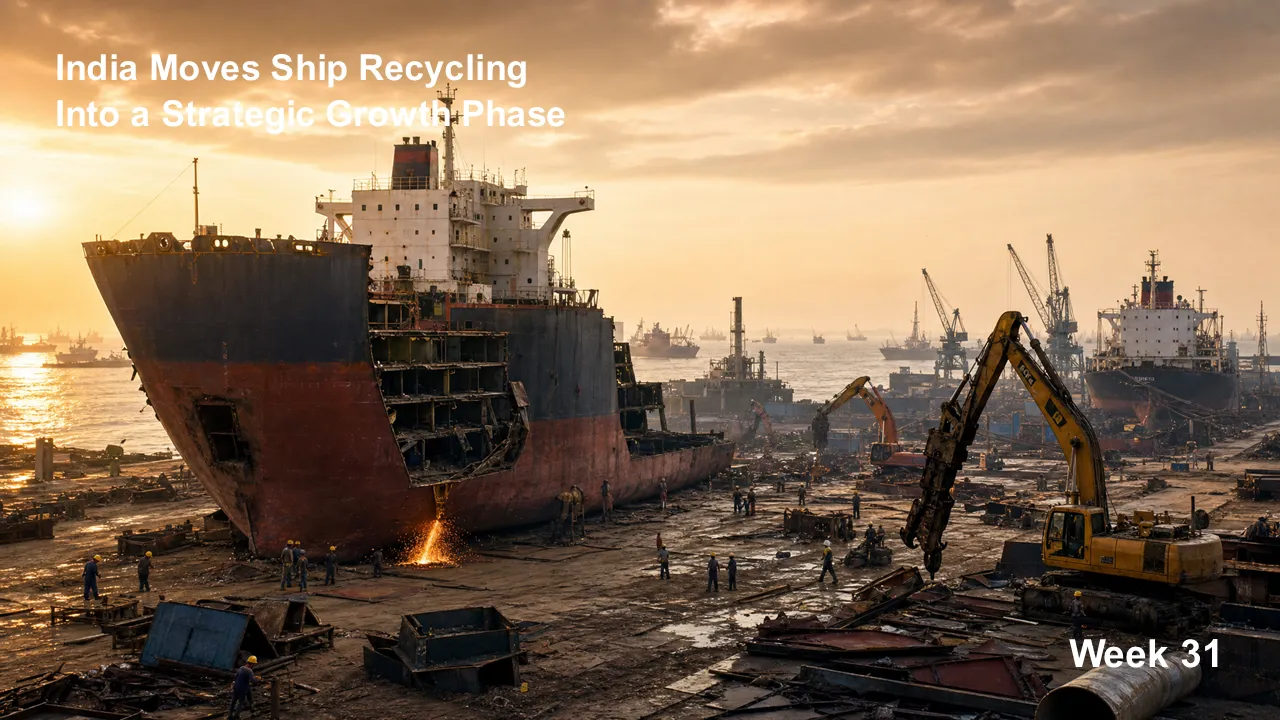
India is moving ship recycling into a more strategic growth phase, with Alang Sosiya remaining the core of its recycling capacity while policy support, yard modernisation and regulatory alignment strengthen the wider platform.
India strengthened its position as the leading global ship recycling destination in 2025, supported by higher recycled volumes and a larger market share, while more than 16,000 ships are expected to reach recycling age globally over the next decade. The country is also moving closer to EU recognition, with the European Commission proposing the addition of Indian facilities to the European List of Ship Recycling Facilities.
At the same time, recycling is being linked more directly with domestic shipbuilding through a credit scheme that allows part of a vessel’s scrap value to support new construction at Indian yards. The near term constraint remains vessel supply rather than recycling appetite, as firm freight markets and secondhand values continue to delay owners’ recycling decisions.
Capesize average earnings were $35,500/day, with the BCI at 4,296 up 0.3% w o w. Panamax average earnings were $18,800/day, with the BPI at 2,087 up 3% w o w. Supramax average earnings were $20,300/day, with the BSI at 1,609 down 5% w o w. Handysize average earnings were $16,000/day, with the BHSI at 887 down 2% w o w.
Capesize South Brazil and West Africa to China recovered after earlier softness, with C3 at $34.16/ton and a 180,000 dwt fixed Itaguai to Qingdao at $33.75/ton.
Panamax strengthened on firmer Atlantic demand and tight prompt tonnage in the North Continent and West Mediterranean, with an 81,000 dwt fixed for a transatlantic round voyage at $23,000/day.
Supramax US Gulf remained under pressure, although increased fixing activity later in the week offered signs of stabilisation, with a 57,000 dwt fixed US Gulf to China via the Cape of Good Hope at $22,000/day.
Handysize softened in the South Atlantic and US Gulf as limited fresh demand and a steady to growing tonnage list weighed on sentiment, with a 36,000 dwt fixed Casablanca via Safi to Abidjan at $15,500/day.
Capesize regained momentum on stronger miner and operator activity, with C5 at $13.05/ton and a 180,000 dwt fixed Port Hedland to Qingdao at $12.50/ton.
Panamax continued to build from recent lows as stronger demand from key loading regions helped absorb available tonnage, with an 82,000 dwt fixed for a North Pacific round voyage at $18,000/day.
Supramax softened as oversupply and weaker North Pacific and Australian demand weighed on sentiment, with a 63,000 dwt fixed Singapore to China at $15,500/day.
Handysize weakened as free tonnage increased across Southeast Asia and the North Pacific while cargo volumes stayed limited, with a 34,000 dwt fixed from Kandla for two laden legs at around $15,000/day.
VLCC strengthened, with TD15 West Africa to China at $117,400/day and TD22 US Gulf to China at $127,700/day as Atlantic routes recovered.
Suezmax earnings rose overall on CPC disruption, although TD20 West Africa to UK Continent fell to $107,500/day and TD27 Guyana to UK Continent fell to $102,800/day.
Aframax corrected from last week’s highs, with TD25 US Gulf to Continent at $108,000/day and TD26 East Coast Mexico to US Gulf at $122,500/day, while TD19 cross Med fell to $114,500/day.
LR was mixed, with TC20 ME Gulf to UK Continent easing to $9.3m.
MR strengthened, with TC21 US Gulf to Caribs at $40,400/day and TC2 Continent to US Atlantic Coast at $6,300/day.
VLCC remained firm in the ME Gulf, with TD3C ME Gulf to China at $446,300/day and TD34 Gulf of Oman to China at WS 163.5, equivalent to $30.53/ton.
Suezmax East of Suez was not the main driver this week, with wider earnings lifted mainly by CPC disruption rather than the Atlantic benchmark routes.
LR held close to last week’s elevated levels, with TC1 ME Gulf to Japan at $140,300/day and TC5 ME Gulf to Japan at $104,800/day.
MR softened in the Far East, with TC7 Singapore to East Coast Australia at $26,500/day.
Over the past twelve months, Greece led secondhand selling with 316 vessels across sectors, versus 160 sales by Chinese sellers. Greek sales were led by 163 dry bulk and 118 tankers, plus 22 containers and 9 gas carriers, while Chinese sales comprised 108 dry bulk, 31 tankers, 11 containers and 5 gas carriers.
On the buying side, Greece recorded 230 purchases and China followed with 212, with Greek buying led by 121 dry bulk and 86 tankers, while Chinese buying was led by 163 dry bulk and 35 tankers.
This post provides a high-level view of India’s evolving ship recycling market and current freight market performance across dry bulk and tanker segments.
The full Allied QuantumSea Weekly Market Report – Week 31 includes:
· In-depth analysis of India’s ship recycling growth strategy and Alang-Sosiya capacity
· Regulatory developments, EU recognition & yard modernisation trends
· Recycling supply dynamics, demolition outlook & links to domestic shipbuilding
· Detailed dry bulk and tanker earnings analysis across all vessel classes
· Atlantic & Pacific route-level freight assessments with key fixture benchmarks
· Baltic indices, TCE calculations & historical market comparisons
· Secondhand S&P transactions, buyer–seller positioning & asset value trends
· Recycling activity and scrap pricing indicators
👉 Fill in the form below to subscribe and receive the complete PDF directly in your inbox every week.