


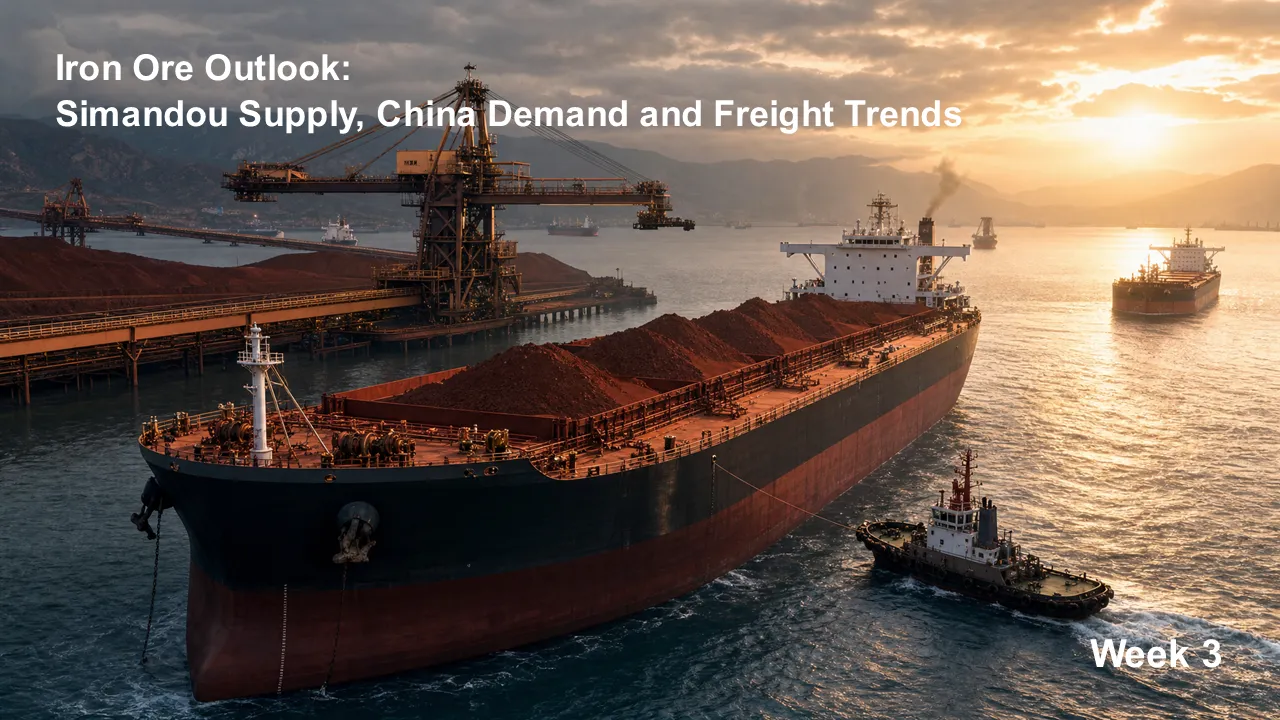
Iron ore prices strengthened in January despite limited improvement in steel demand and still elevated inventories in China, with support driven mainly by sentiment and expectations of policy support. Simandou moved from future risk to active supply as its first commercial cargo reached China in January, confirming Guinea is now an active supplier of high grade ore, while near term volumes are expected to remain limited. China’s steel backdrop remains weak as domestic consumption continues to decline amid the property downturn and measures to curb excess capacity, while imports stay firm and port inventories remain high. Capesize earnings weakened through January, and while dry bulk shipping rates have rebounded early this week, the report links this to improved sentiment while underlying demand conditions still look soft.
Capesize average earnings were $20,200 per day, with the BCI down 16% w o w. Panamax average earnings were $13,100 per day, with the BPI up 8.5% w o w. Supramax average earnings were $12,200 per day, with the BSI unchanged w o w. Handysize average earnings were $10,600 per day, with the BHI down 3% w o w.
Capesize South Brazil and West Africa to China weakened midweek before stabilising toward the close, including a Tubarao to China fixture at $20.50 per ton. Panamax saw fronthaul as the main support, including an EC South America to Singapore Japan trip at $14,750 per day plus a $475,000 ballast bonus. Supramax had the US Gulf as the brighter spot but the wider basin stayed quiet. Handysize remained soft with a long tonnage list and limited fresh enquiry.
Capesize miner activity continued but was not enough to absorb available tonnage, with C5 easing into the low $7s per ton, including a Port Hedland to Qingdao fixture at $8.20 per ton. Panamax sentiment improved as the week progressed, including a Yangzhong to Singapore Japan trip at $9,500 per day. Supramax conditions stayed soft overall, including a China to Bangladesh trip at mid $13,000s per day. Handysize cargo volume was thin and owners trimmed ideas to secure cover, including a Rizhao to the West Coast of India trip at $10,000 per day.
VLCC freight improved, with TD15 assessed at WS113 and TD22 at $14.3m. Suezmax strengthened with TD20 at WS166.11 and TD27 at WS158, while Aframax climbed with TD26 just over WS301 and TD9 almost WS287, and MR held firm with TC14 at WS204 and TC2 improving to WS121.
VLCC continued the rebound in the MEG, with TD3C assessed at WS112. Aframax firmed with TD28 at $2.9m and TD29 at WS218, while MEG clean strengthened with LR2 TC1 at WS216 and LR1 TC5 at WS226, and MR jumped with TC17 at WS292.
Over the past twelve months, Greek interests led selling with 281 vessels across sectors, versus 130 for Chinese sellers. Greek selling was led by 138 dry bulk and 91 tankers, plus 41 containers and 5 gas carriers, while Chinese selling comprised 80 dry bulk, 34 tankers, 8 containers and 5 gas carriers. On the buying side, China ranked first with 227 purchases and Greece followed with 185, with Chinese buying led by 157 dry bulk and 54 tankers and Greek buying led by 111 dry bulk and 50 tankers.
This post offers a high-level view of iron ore market sentiment, China demand dynamics, and current freight market performance.
The full Allied QuantumSea Weekly Market Report includes:
· In-depth iron ore market analysis covering Simandou supply, China steel demand & inventory trends
· Detailed Capesize freight assessment and sentiment vs fundamentals breakdown
· Full dry bulk earnings tables across all vessel classes
· Route-level Atlantic & Pacific freight analysis
· Tanker market coverage with key dirty & clean benchmarks
· Baltic indices, TCE tables & historical comparisons
· Secondhand S&P activity, buyer–seller trends & asset value movements
· Recycling activity and scrap price benchmarks
👉 Fill in the form below to subscribe and receive the complete PDF directly in your inbox every week.