


Dry bulk diverged sharply in Week 42 as weakening iron ore enquiry hit Capesize earnings and Panamax slipped, while smaller bulk carriers continued to improve. The Baltic Dry Index fell 13.9% to 2,511. Dirty tanker earnings eased from elevated levels, with the BDTI down 5.1%, but clean products strengthened and the BCTI gained 5.6% to a 12-month high. Secondhand activity cooled in both dry bulk and tankers, although buying remained evident in geared bulkers, Suezmaxes and MRs.
Capesize freight entered October under pressure: average rates on Brazil–China and West Australia–China iron ore routes were about 18% below their September averages in the first half of the month. China imported 109.82 million tonnes of iron ore in September, its highest monthly volume of Q3, but still 5.6% below a year earlier. First-nine-month imports rose 4.1% year on year, while January–August crude steel output fell 3.1% and property investment declined 20%. Higher ore arrivals therefore do not, on their own, establish a lasting recovery in steel-driven shipping demand.
Brazilian iron ore exports, excluding pellets, fell 8.0% month on month to 31.66 million tonnes in September. Smaller producers adjusted production amid weaker economics: CSN Mineração cut its 2026 production-plus-purchases guidance by 6 million tonnes to 39–41 million tonnes, and other operators announced suspensions or processing changes. These steps may curb fresh Atlantic cargo supply, but production curtailments should not be treated as equivalent to cancelled sailings. Vale offers some offset, with Q2 output up 1% to 84.3 million tonnes; benefits from some expansion projects are expected from 2027.
Australia and Guinea offer different potential supports. Rio Tinto’s Pilbara Q3 shipments reached 85.7 million tonnes, up 2% year on year, while Fortescue shipped 46.8 million tonnes, down 6% amid maintenance. Guinea’s SimFer shipped 2.2 million tonnes to China in Q3, up 36% quarter on quarter, adding long-haul employment; these figures cover SimFer, not all of Simandou, and the net lift depends on trade displacement. Higher diesel costs and ocean freight continue to pressure marginal ore economics. For Q4, the decisive question is whether Brazilian loadings and other exports recover enough to absorb available Capesize tonnage.
Weaker Atlantic cargo enquiry and a softer Pacific pushed BCI-TCE down 27.6% to $25,961/day and the BCI down 25.1% to 3,249. Tubarao–Rotterdam C2 lost 23% and Tubarao–Qingdao C3 declined 10%; Polaris reportedly fixed 170,000 tonnes Tubarao–Qingdao on Herodotus at $30.50/tonne for 15–20 November. West Australia–Qingdao C5 fell 18%, despite firmer late-week bids. Rio Tinto fixed 170,000 tonnes Dampier–Qingdao at $11.25/tonne for 31 October–2 November.
The BPI and BPI-TCE both lost 4.5%, to 2,314 and $20,827/day. Sparse Atlantic grain enquiry and ample tonnage weighed on fronthaul: P1A Atlantic rounds fell 8%. The Pacific was mixed as Australian and North Pacific cargoes remained visible but negotiations slowed; P5 China–Hong Kong rose 10%, against a 9% fall on P6 Singapore–Far East. Dayu (85,180 dwt) was fixed via Australia with coal at $24,500/day.
The BSI rose 2.8% to 1,865, a 12-month high, and BSI-TCE gained 3.1% to $21,539/day. Atlantic US Gulf and Continent enquiry supported trips, with S1B South Baltic/Mediterranean–Far East up 3%. Pacific S2 rounds climbed 5% and S8 South China–East India 4%. Tomini Pine (63,684 dwt) was fixed via the North Pacific to Indonesia at $25,000/day.
Handysize outperformed the larger bulkers: BHSI and BHSI-TCE gained 1.5%, to 1,011 and $18,200/day. Atlantic 3_38 Rio–Skaw rose 7%, although 4_38 US Gulf–Skaw fell 5%; Pacific 6_38 rounds added 3% despite accumulating prompt tonnage in the south. Hope (34,146 dwt) fixed from Tuticorin to the Continent with steel at $13,500/day.
VLCC-TCE eased 5.7% to $883,372/day, while one-year period rates rose 11.0% to $303,500/day. Middle East Gulf fresh enquiry thinned, although the 30-day vessel count stood at 99, down two from 14 October. TD3C Middle East Gulf–China slipped 2%; slower US Gulf and West African activity pulled TD22 US Gulf–China down 13% and TD15 West Africa–China down 7%.
Suezmax-TCE was unchanged at $700,137/day even as Atlantic routes split. Renewed CPC enquiry supported a reported TD6 Black Sea–Mediterranean fixing at WS1,150 and a 7% weekly route gain; TD20 West Africa–UK Continent fell 10%. Arabian Gulf demand was quiet and TD23 remained unchanged. Front Crown (157,460 dwt, 2016) fixed a three-year period to Clearlake at $80,000/day for October delivery Oman.
Aframax-TCE declined 14.6% to $328,345/day as Atlantic tonnage availability expanded. TD26 East Coast Mexico–US Gulf dropped 38%, and TD9 Caribbean–US Gulf and TD15 US Gulf–UK Continent each lost 36%; North Sea and Mediterranean routes also weakened. In the East, TD14 Southeast Asia–Australia gained 4%, while TD8 Middle East Gulf–Singapore held steady.
On 15 October, TC1 LR2 Arabian Gulf–Japan stood at WS986 and an assessed $300,250/day TCE, up 57 Worldscale points and $18,250/day against 8 October. TC5 LR1 reached WS982 and $215,250/day TCE, up 41 points and $9,250/day. Eastern business was reported at 75,000 tonnes/WS725 for LR2 and 55,000 tonnes/WS600 for LR1, but new enquiry slowed as charterers weighed high costs; Mediterranean–Japan LR2 voyage rates were assessed at $18.5 million, versus $15.0 million the prior week.
The Atlantic MR basket advanced 40.2% to $63,419/day, led by a 67% surge on TC14 US Gulf–Continent. TC18 US Gulf–Brazil reached WS460 and $64,000/day on 15 October as ships repositioned from northern Europe. The Pacific basket rose 6.2% to $81,008/day, with TC10 South Korea–North Pacific up 15%, although Arabian Gulf prompt supply appeared and TC17 eased to WS565. MR one-year rates increased 4.7% to $45,000/day.
Reported dry bulk secondhand sales eased to five vessels from seven the previous week, with $77.7 million of reported consideration across all five. Two Panamax/Kamsarmax and two Supramax/Ultramax transactions led activity, alongside one Handysize; no Capesize sale was recorded in that weekly dry bulk tally. Chinese interests reportedly bought the 79,440 dwt WEI HE (2012) for $16.1 million, while Heng Fa Shipping acquired the 55,496 dwt JIN XING (2007) for $14.6 million. The 37,993 dwt STELLAR ISABELA (2017) was reported sold for $25.4 million.
Tanker transactions also slowed, to 11 vessels from 17, with more than $358.65 million reported across nine priced ships. Five MRs led, followed by three Aframax/LR2s, two Suezmaxes and one product/chemical tanker. The Suezmaxes ACHILLEAS (157,883 dwt, 2010) and scrubber-fitted ZOUZOU N. (149,991 dwt, 2010) were reported sold for $98.0 million and $103.0 million respectively. The MR HIGH FIDELITY (49,990 dwt, 2014) was reported at $14.0 million to d’Amico International SA under an existing bareboat purchase option. The report does not identify a Greek buyer for any of this week’s listed secondhand vessel transactions; Greek participation is evident in the separate rolling buyer statistics.
As of 16 October 2026, Allied’s secondhand table records 1,415 vessels sold year to date, totalling 121.87 million dwt. Dry bulk accounts for 613 vessels (43.3%), tankers 541 (38.2%), containers 135, gas carriers 58 and other vessels 68. Within bulk, Supra/Ultramax leads with 236 sales, followed by Handysize (136), Pana/Kamsarmax (134), Capesize/VLOC (61), Post Panamax (44) and small bulk (2). Tanker deals comprise 159 MRs, 124 VLCCs, 74 small tankers, 72 Suezmax/LR3, 67 Aframax/LR2 and 45 Panamax/LR1.
Buyer nationality figures cover the past twelve months, not the 2026 YTD period. Over that rolling period, Greek buyers acquired 237 vessels across sectors, including 109 dry bulk carriers and 99 tankers; Chinese buyers acquired 216, including 168 bulkers and 34 tankers. Greek sellers accounted for 326 reported disposals and Chinese sellers for 164.
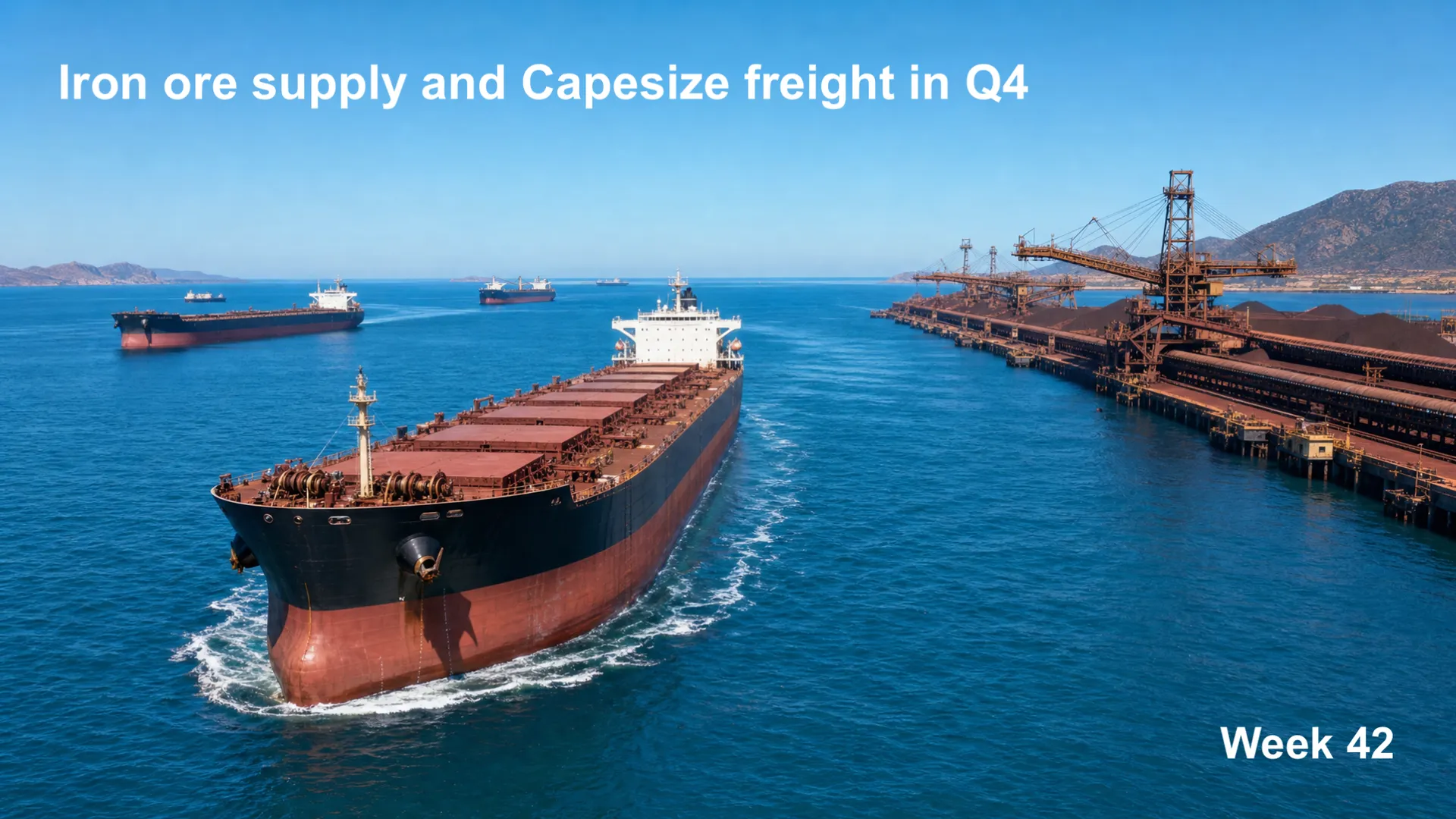
This week’s roundup examines Q4 iron ore supply and Capesize freight, the latest dry and wet freight shifts, and reported secondhand vessel sales.
The full Allied QuantumSea Weekly Market Report – Week 42 includes:
· Brazilian export cuts, Australian loading programmes and SimFer’s Guinea–China ramp-up
· Chinese iron ore imports, steel indicators and the implications for Q4 cargo demand
· Producer cost pressures and their potential effect on Atlantic Capesize employment
· Dry bulk and tanker TCE benchmarks, indices, route movements and reported fixtures
· Secondhand vessel transactions, indicative asset values and 2026 activity by sector and size
· Past-12-month buyer and seller nationality figures, newbuilding orders and ship recycling data
👉 Fill in the form below to subscribe and receive the complete PDF directly in your inbox every week.