


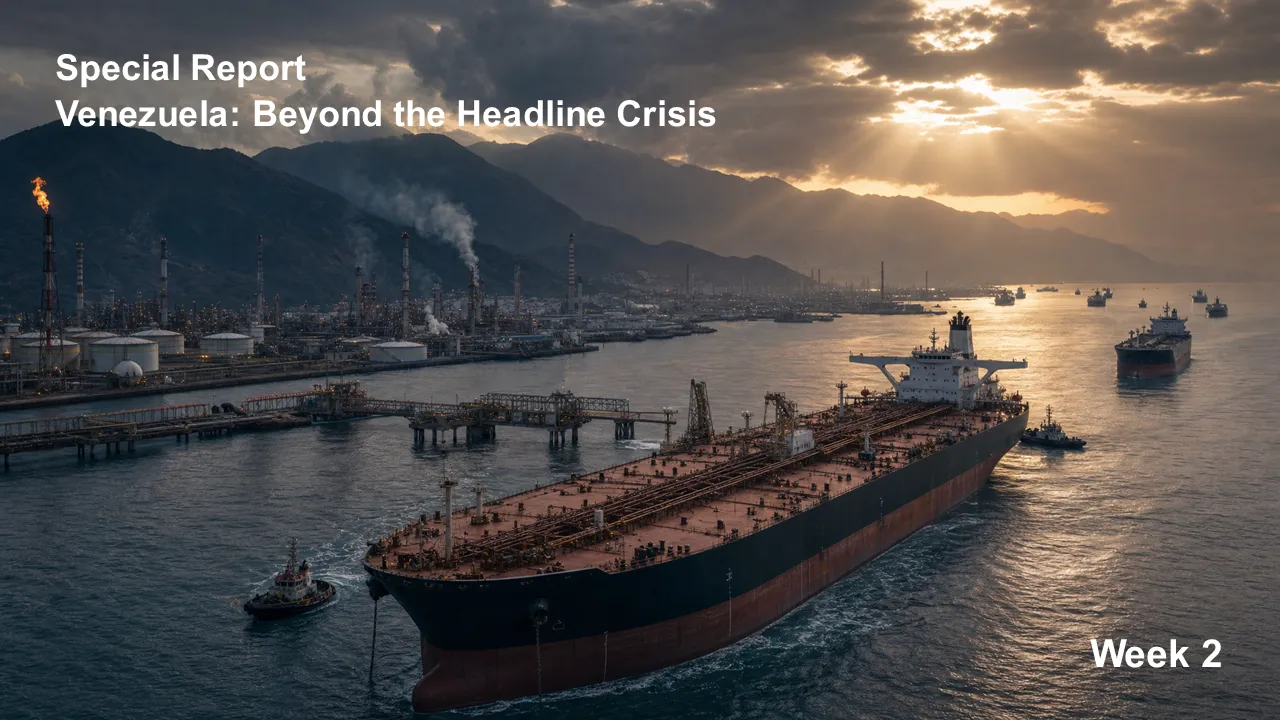
Venezuela remains under sanctions that could remove most export revenues through 2026, while crude output has fallen sharply after years of underinvestment, infrastructure decline and limited market access. Most exports move to Asia, mainly China, often at deep discounts that reflect sanctions risk, logistics and intermediary costs. Sanctions era trade has relied on shadow fleets, higher insurance and demurrage, and long haul routes to Asia that raise tonne mile demand and freight risk across tanker chartering markets. Recent moves by Vitol and Trafigura to market authorised Venezuelan crude to China replace irregular flows with documented, licensed shipments, reducing counterparty risk while keeping long haul tonne miles in place. Focus is now on reintegration, with heavy crude pricing, blending economics and diluent availability expected to move before export volumes improve.
Capesize average earnings were $24,000 per day, with the BCI 5TC down 17.2% w o w. Panamax average earnings were $12,100 per day, with the BPI 5TC up 5.0% w o w. Supramax average earnings were $12,200 per day, with the BSI 5TC down 11.9% w o w. Handysize average earnings were $11,000 per day, with the BHSI 5TC down 11.6% wow.
Capesize saw South Brazil and West Africa to China split by laycan, with end January cargoes holding a premium while February stems traded lower and C3 bids slipped to around $20.5 per ton. Panamax stayed relatively stable, with fronthaul helping to clear prompt tonnage. Supramax was quiet as enquiry thinned. Handysize remained under pressure, with a long tonnage list and limited fresh interest across most load areas.
Capesize pressure built as activity picked up after the holidays but tonnage grew faster than demand, with C5 fixing seen around $8.00 per ton by week end. Panamax closed firmer as Indonesian demand improved. Supramax stayed pressured by heavy prompt tonnage and thin fixing. Handysize owners trimmed ideas to secure cover amid limited cargo availability.
VLCC rates improved, with TD15 rising to about WS73 and TD22 recovering to $9.6m. Suezmax turned firmer with TD20 around WS128 and TD27 near WS132, while Aframax stayed stronger in the Americas with TD26 at WS247, TD9 at WS235 and TD25 at WS221.
VLCC strengthened in the MEG with TD3C up to WS74. Pacific Aframax export routes improved, while MEG clean markets firmed with LR2 TC1 at WS180 and LR1 TC5 at WS190 and MR TC17 was assessed at WS240 with round trip earnings quoted at $24,800 per day.
Over the past twelve months, Greek interests led selling with 287 vessels across sectors, versus 133 for Chinese sellers. Greek selling was led by 142 dry bulk and 91 tankers, plus 42 containers and 5 gas carriers, while Chinese selling comprised 82 dry bulk, 34 tankers, 8 containers and 5 gas carriers. On the buying side, China ranked first with 229 purchases and Greece followed with 185, with Chinese buying led by 159 dry bulk and 54 tankers and Greek buying led by 111 dry bulk and 50 tankers.
This post offers a high-level overview of Venezuela-related trade dynamics and current freight market conditions.
The full Allied QuantumSea Weekly Market Report – Week 02 includes:
· In-depth geopolitical and sanctions analysis on Venezuela
· Detailed crude trade flow assessment, pricing mechanics & blending economics
· Route-level freight analysis across dry bulk & tanker markets
· Atlantic & Pacific basin breakdowns with rate evolution
· Baltic indices, TCE tables & comparative weekly performance
· Newbuilding and fleet supply indicators
· Secondhand S&P transactions, buyer–seller positioning & asset value trends
· Recycling activity and scrap pricing benchmarks
👉 Fill in the form below to subscribe and receive the complete PDF directly in your inbox every week.